DECEMBER 28
1856 – BIRTH OF WOODROW WILSON, 28TH PRESIDENT OF THE UNITED STATES
“A great industrial nation is controlled by its system of credit. Our system of credit is privately concentrated. The growth of the nation, therefore, and all our activities are in the hands of a few men who, even if their action be honest and intended for the public interest, are necessarily concentrated upon the great undertakings in which their own money is involved and who necessarily, by very reason of their own limitations, chill and check and destroy genuine economic freedom.”
DECEMBER 31
1781 – BANK OF NORTH AMERICA ESTABLISHED
This was the nation’s first private commercial bank. The Articles of Confederation was the nation’s constitution at that time. Article 9 of the Articles gave Congress the power to “emit bills of credit” -- to create money. By a single vote, Congress voted to willingly transfer their authority to issue money to the The Bank of North America when it chartered the bank on December 31, 1781. Thus, the Bank served as a quasi national central bank. Why did Congress willingly give up their money power? The public argument was that the business of finance could not be ably conduced by a public body (Congress) — only by a small number of private financiers. The first head of the Bank was Robert Morris, the richest merchant in America. This same argument against public issuance of money is made today – a public body can’t be trusted to create and distribute our nation’s money supply. The result is the creation and distribution of our nation’s money supply by banking corporations.
--------------------
Why this calendar? Many people have questions about the root causes of our economic problems. Some questions involve money, banks and debt. How is money created? Why do banks control its quantity? How has the money system been used to liberate (not often) and oppress (most often) us? And how can the money system be “democratized” to rebuild our economy and society, create jobs and reduce debt?
Our goal is to inform, intrigue and inspire through bite size weekly postings listing important events and quotes from prominent individuals (both past and present) on money, banking and how the money system can help people and the planet. We hope the sharing of bits of buried history will illuminate monetary and banking issues and empower you with others to create real economic and political justice.
This calendar is a project of the Northeast Ohio American Friends Service Committee. Adele Looney, Phyllis Titus, Donna Schall, Leah Davis, Alice Francini and Greg Coleridge helped in its development.
Please forward this to others and encourage them to subscribe. To subscribe/unsubscribe or to comment on any entry, contact monetarycalendar@yahoo.com For more information, visit http://www.afsc.net/economiccrisis.html
Sunday, December 25, 2011

Saturday, December 24, 2011
MONETARY HISTORY CALENDAR - Special Christmas Eve edition
DECEMBER 24
1294 – PAPACY OF POPE BONIFACE VIII BEGINS
Benedetto Gaetani became Pope of the Catholic Church on Christmas Eve, 1294. He instituted the first Christian “Jubilee” in 1300. Jubilee has both Jewish and Christian roots. According to Wikipedia, “The concept of the Jubilee is a special year of remission of sins and universal pardon. In the Biblical Book of Leviticus, a Jubilee year is mentioned to occur every fifty years, in which slaves and prisoners would be freed, debts would be forgiven and the mercies of God would be particularly manifest.” It was also common for land to be returned. Pope Boniface VIII conditioned the forgiving of sins and debt on personal confessions and pilgrimages to sacred sites (i.e. basilicas of St. Peter and St. Paul in Rome) at least once a day for a specified time.
----------------------------
Why this calendar? Many people have questions about the root causes of our economic problems. Some questions involve money, banks and debt. How is money created? Why do banks control its quantity? How has the money system been used to liberate (not often) and oppress (most often) us? And how can the money system be “democratized” to rebuild our economy and society, create jobs and reduce debt?
Our goal is to inform, intrigue and inspire through bite size weekly postings listing important events and quotes from prominent individuals (both past and present) on money, banking and how the money system can help people and the planet. We hope the sharing of bits of buried history will illuminate monetary and banking issues and empower you with others to create real economic and political justice.
This calendar is a project of the Northeast Ohio American Friends Service Committee. Adele Looney, Phyllis Titus, Donna Schall, Leah Davis, Alice Francini and Greg Coleridge helped in its development.
Please forward this to others and encourage them to subscribe. To subscribe/unsubscribe or to comment on any entry, contact monetarycalendar@yahoo.com For more information, visit http://www.afsc.net/economiccrisis.html
1294 – PAPACY OF POPE BONIFACE VIII BEGINS
Benedetto Gaetani became Pope of the Catholic Church on Christmas Eve, 1294. He instituted the first Christian “Jubilee” in 1300. Jubilee has both Jewish and Christian roots. According to Wikipedia, “The concept of the Jubilee is a special year of remission of sins and universal pardon. In the Biblical Book of Leviticus, a Jubilee year is mentioned to occur every fifty years, in which slaves and prisoners would be freed, debts would be forgiven and the mercies of God would be particularly manifest.” It was also common for land to be returned. Pope Boniface VIII conditioned the forgiving of sins and debt on personal confessions and pilgrimages to sacred sites (i.e. basilicas of St. Peter and St. Paul in Rome) at least once a day for a specified time.
----------------------------
Why this calendar? Many people have questions about the root causes of our economic problems. Some questions involve money, banks and debt. How is money created? Why do banks control its quantity? How has the money system been used to liberate (not often) and oppress (most often) us? And how can the money system be “democratized” to rebuild our economy and society, create jobs and reduce debt?
Our goal is to inform, intrigue and inspire through bite size weekly postings listing important events and quotes from prominent individuals (both past and present) on money, banking and how the money system can help people and the planet. We hope the sharing of bits of buried history will illuminate monetary and banking issues and empower you with others to create real economic and political justice.
This calendar is a project of the Northeast Ohio American Friends Service Committee. Adele Looney, Phyllis Titus, Donna Schall, Leah Davis, Alice Francini and Greg Coleridge helped in its development.
Please forward this to others and encourage them to subscribe. To subscribe/unsubscribe or to comment on any entry, contact monetarycalendar@yahoo.com For more information, visit http://www.afsc.net/economiccrisis.html
Friday, December 23, 2011
Counting Down to Christmas...
Have a Merry Christmas and a Happy New Year - we'll see you again in 2012! Until then, for the sake of all those people who are spending way too much time wrapping presents this season, here's our official countdown clock until the big day....

Thursday, December 22, 2011
Should You Wait to Take Social Security?
Does it pay to delay taking Social Security benefits?

Let's say you're considering one of three options: taking early retirement at Age 62, retiring at the traditional Age 65, or really holding off on retiring until you've reached Age 70. Which choice might be better for you?
The question matters because people who wait longer before drawing Social Security benefits can draw larger benefits than those who don't wait.
To find the answer, we've tapped Social Security's estimate of the maximum possible Social Security benefits that would be paid for individuals choosing to begin receiving payments in the first month after they've reached each of these ages in January 2012.
We then projected the accumulated total amount of benefits each individual would receive all the way out to Age 100.
But since most Americans won't live quite that long, we also projected how much longer a typical American can expect to live once they've reached the age at which they begin receiving Social Security benefits.
We've presented our results in the following chart, where we've used a solid line to indicate the portion of benefits that would be accumulated based upon a typical American's likely remaining life expectancy, and a dashed line to cover the period from that age all the way out to Age 100.

What we find is that based upon the typical life expectancy for most Americans, it does indeed pay to wait longer to draw Social Security benefits after becoming eligible.
For example, an individual who waits until the traditional Age 65 to begin receiving Social Security benefits will accumulate more money from the program than an individual who begins drawing benefits at Age 62 by the time both have reached Age 77. Since most Americans who reach either age can expect to live into their 80s, they would do better to wait than to take early retirement.
Likewise, by the time an individual reaches Age 82, they will have accumulated more benefits from Social Security by having waited to start receiving them at Age 70 than they will have by beginning to take them at Age 65.

There are two big wild cards in all this however. First is the major unknown of how long you will actually live - if you knew that, then you would know exactly which option might be better for your situation.
That's also complicated by whether or not you have a spouse. In that case, your Social Security benefits would continue to be paid to them in the form of survivor's benefits throughout the rest of their lives, which matters because they might live long beyond your years. That factor would argue in favor of waiting.
The second big wild card however is whether you have another source of income that can carry you from Age 62 through Age 70. Whether that's from regular retirement income that you set aside throughout your working years or from a job, both of which might be at the mercy of the economy, you might find it necessary to begin drawing benefits long before you would otherwise have chosen to do so in an ideal world.
Wednesday, December 21, 2011
How Much Does It Cost to Own an ETF?
If you're an investor looking to possibly put your money into an Exchange Traded Fund (ETF), how much can you expect that will that cost you?

ETFs are a lot like mutual funds, in that they are made up of a number of individual stock or bond holdings and have operating expenses that will be charged against your account, but they're not exactly. Unlike mutual funds, which are only allowed to change hands at the end of a business day, you can actively trade an ETF - placing market orders to buy and sell at any time when the market is open, just like the shares of stock or bonds you might own.
Combined, those characteristics make an ETF something of a hybrid between mutual funds and regular stocks. Which means that figuring out how much it costs you to own an ETF is a little more involved than looking at the fund's Operating Expense Ratio.
If you're shopping for an ETF, and you're looking to minimize your costs as a way to help maximize your return on your investment, you'll also need to consider the funds Bid-Ask Spread, the value of any trading commission you might have to pay, as well as how long you plan to keep your money in the ETF and also how much money you'll keep in the ETF.
Fortunately, our newest tool is here to do the job for you! Based on math presented by Michael Iachini in the Winter 2011 edition of Charles Schwab's On Investing magazine (the link will work once the print edition is published online), our latest tool can help you find out how much it owning an ETF will really cost you!
Just enter the relevant data below, and we'll do the rest!
Using the default values in the tool, we find that the approximate annual ownership cost for investing $10,000 for half a year in an ETF with an Operating Expense Ratio of 0.10%, a Bid-Ask Spread of 0.15% and a per-trade commission of $8.95 is 0.76%, or $75.80.
Different ETFs and different brokers however will have very different numbers. Using our tool will help give you a good way to compare the relative costs of owning those ETFs when it matters most: before you choose to invest in them!
Image Credit: The Digerati Life
Tuesday, December 20, 2011
Building Your Groupon Discount Promotion
 If you run a business and are looking at running a marketing campaign offering discounts on your products or services through social media marketing sites like Groupon or Living Social, what kind of discounts can you really afford to offer?
That question comes up because of a recent story from the United Kingdom, where Woodley baker Rachel Brown was forced to make 102,000 cupcakes to satisfy a torrent of customers who took advantage of the discount she had offered via Groupon, losing $20,000 in the process. Mashable's Stan Schroeder reports:
Group discounts can be a nice thing for both the seller and the customers, but you have to know your limits. A UK baker learned that the hard way, when she was forced to bake 102,000 cupcakes, after offering a 75% cupcake discount on Groupon.
The discount obviously sounded too good to Grouponers, 8,500 of whom signed up to buy 12 cupcakes for £6.50 ($10), down from the standard £26 ($40) price. Rachel Brown, who operates the Need a Cake bakery in Woodley (near Reading, UK), had to hire extra workers and try to bake the cupcakes to satisfy the swarming customers.
"Without doubt, it was my worst ever business decision. We had thousands of orders pouring in that really we hadn’t expected to have. A much larger company would have difficulty coping," said Brown, who lost up to £12,500 ($20,000) on the deal.
There's a lot that went wrong for our cupcake-baking heroine, but thanks to the folks at TheDealMix, who developed the formulas, we can now present a tool using simplified math that can help any business owner set up a deal for discounts to avoid the pitfalls into which Rachel Brown's bakery fell.
Just answer the following questions as they apply for your business - our tool will do the rest to help ensure that your business can handle the demand from your deal while still running in the black!
Our tool's results are designed to ensure that your business can afford to support the discount promotion you're thinking about running in two ways. First, by adding a positive amount to your Cost of Goods or Services Sold, you'll avoid the situation where you might discount your promoted item too greatly.
Second, by placing a limit on the number of deals that will be offered through your promotion, you'll largely avoid having to go to extraordinary means to satisfy customer demand should your promotion prove to be extremely popular.
And now, you shouldn't have to worry about whatever the equivalent of losing $20,000 to bake 102,000 cupcakes is for your business!
Monday, December 19, 2011
MONETARY HISTORY CALENDAR December 19-25
DECEMBER 23
1913 – FEDERAL RESERVE ACT PASSES CONGRESS - CREATING FEDERAL RESERVE SYSTEM
The Act created a largely corporate controlled national banking and currency system. It was a major coup for banking corporations through the establishment of a private central bank authorized to "monetize" government debt (i.e. to print their own money and exchange it for government securities or I.O.U.'s). The central banking system was composed of 12 regional private/corporate banks owned by participating commercial banks. All national banks were required to join the system. Banking corporations now controlled the issuance and circulation of our national currency. By controlling our national money faucet, they could create inflation and deflation. This corporate monopolization of our currency allowed for public regulation, but not control. It was now banking corporations, not the US government, that was in control of the national currency.
DECEMBER 25
2011 YEARS AGO – CLAIMED BIRTH DATE OF JESUS
In his book, Money and its True Function, author FR Burch said, “As long as Christ confined his teachings to the realm of morality and righteousness, He was undisturbed; it was not till He assailed the established economic system and 'cast out' the protiteers and 'overthrew the tables of the money changers,' that He was doomed. The following day He was questioned, betrayed on the second tried on the third and on the fourth crucified.”
1983 – DEATH OF ROBERT H. HEMPHILL, CREDIT MANAGER, ATLANTA FEDERAL RESERVE BANK
"This is a staggering thought. We are completely dependent on the Commercial Banks. Someone has to borrow every dollar we have in circulation, cash or credit. If the Banks create ample synthetic money, we are prosperous; if not, we starve. We are absolutely without a permanent money system. When one gets a complete grasp of the picture, the tragic absurdity of our hopeless position is almost incredible, but there it is. "
------------
Why this calendar? Many people have questions about the root causes of our economic problems. Some questions involve money, banks and debt. How is money created? Why do banks control its quantity? How has the money system been used to liberate (not often) and oppress (most often) us? And how can the money system be “democratized” to rebuild our economy and society, create jobs and reduce debt?
Our goal is to inform, intrigue and inspire through bite size weekly postings listing important events and quotes from prominent individuals (both past and present) on money, banking and how the money system can help people and the planet. We hope the sharing of bits of buried history will illuminate monetary and banking issues and empower you with others to create real economic and political justice.
This calendar is a project of the Northeast Ohio American Friends Service Committee. Adele Looney, Phyllis Titus, Donna Schall, Leah Davis, Alice Francini and Greg Coleridge helped in its development.
Please forward this to others and encourage them to subscribe. To subscribe/unsubscribe or to comment on any entry, contact monetarycalendar@yahoo.com For more information, visit http://www.afsc.net/economiccrisis.html
1913 – FEDERAL RESERVE ACT PASSES CONGRESS - CREATING FEDERAL RESERVE SYSTEM
The Act created a largely corporate controlled national banking and currency system. It was a major coup for banking corporations through the establishment of a private central bank authorized to "monetize" government debt (i.e. to print their own money and exchange it for government securities or I.O.U.'s). The central banking system was composed of 12 regional private/corporate banks owned by participating commercial banks. All national banks were required to join the system. Banking corporations now controlled the issuance and circulation of our national currency. By controlling our national money faucet, they could create inflation and deflation. This corporate monopolization of our currency allowed for public regulation, but not control. It was now banking corporations, not the US government, that was in control of the national currency.
DECEMBER 25
2011 YEARS AGO – CLAIMED BIRTH DATE OF JESUS
In his book, Money and its True Function, author FR Burch said, “As long as Christ confined his teachings to the realm of morality and righteousness, He was undisturbed; it was not till He assailed the established economic system and 'cast out' the protiteers and 'overthrew the tables of the money changers,' that He was doomed. The following day He was questioned, betrayed on the second tried on the third and on the fourth crucified.”
1983 – DEATH OF ROBERT H. HEMPHILL, CREDIT MANAGER, ATLANTA FEDERAL RESERVE BANK
"This is a staggering thought. We are completely dependent on the Commercial Banks. Someone has to borrow every dollar we have in circulation, cash or credit. If the Banks create ample synthetic money, we are prosperous; if not, we starve. We are absolutely without a permanent money system. When one gets a complete grasp of the picture, the tragic absurdity of our hopeless position is almost incredible, but there it is. "
------------
Why this calendar? Many people have questions about the root causes of our economic problems. Some questions involve money, banks and debt. How is money created? Why do banks control its quantity? How has the money system been used to liberate (not often) and oppress (most often) us? And how can the money system be “democratized” to rebuild our economy and society, create jobs and reduce debt?
Our goal is to inform, intrigue and inspire through bite size weekly postings listing important events and quotes from prominent individuals (both past and present) on money, banking and how the money system can help people and the planet. We hope the sharing of bits of buried history will illuminate monetary and banking issues and empower you with others to create real economic and political justice.
This calendar is a project of the Northeast Ohio American Friends Service Committee. Adele Looney, Phyllis Titus, Donna Schall, Leah Davis, Alice Francini and Greg Coleridge helped in its development.
Please forward this to others and encourage them to subscribe. To subscribe/unsubscribe or to comment on any entry, contact monetarycalendar@yahoo.com For more information, visit http://www.afsc.net/economiccrisis.html
S&P 500: In the Zone!
Nobody can predict where stock prices will go next, can they? Especially given the volatility of stock prices, especially in today's market, where the market can swing by more than 3% in any given day, right?
It's just not possible, is it?
To really find out, we ran a two-year long experiment, from April 2009 through April 2011, to see if we could forecast the average value of stock prices for a month at the end of the previous month. Here were our final results:

As you can see, we offered a split final forecast option for April 2011. Here's what we believed would happen instead:
What we believe is likely is that stock prices will track upward from the average level of 1304 they recorded in March 2011 toward the 1393-1429 level our primary method would forecast as the noise currently in the market subsides.
And that's what happened. In April 2011, stock prices did indeed track upward, rising to an average level of 1331 for the month, with the S&P closing the month at 1363.61.
We took the next several months off from offering public forecasts of where the S&P 500 would head next, but by 26 September 2011, we couldn't resist any more, and posted the following chart, which presents a graphical prediction that happens to cover the period through the end of 2011:

And here's what the updated chart looks like, through the end of 16 December 2011:

What can we say? We're still in the zone! And that concludes, for real this time, our public experiment in forecasting the future for the S&P 500!
Friday, December 16, 2011
The Invisible Hand App
If you use Google's Chrome web browser, there's a relatively new app that can make shopping a lot more economical: InvisibleHand.
When you're reviewing a commercial web site when shopping for a product, such as airline tickets, rental cars, or even dog food, InvisibleHand will let you know if you can buy the product more cheaply at other sources and link to them. We snapped the screen shot below to show what the discreet prompt looks like when it finds a lower price, which appears at the top of the browser window:

We've only been test driving it for a little while, but our initial impression is that the app is pretty cool! The app is free and versions are also available for the Firefox, Safari and Internet Explorer web browsers from InvisibleHand's web site.
Elsewhere on the Web
Carolyn Nicander Mohr offers a positive review of the InvisibleHand app.
C|net's Rafe Needleman reconsiders his initial positive review for the app based upon privacy issues related to cross-site data leakage, where his search for a product on one site was unknowingly communicated to Amazon's site.
Thursday, December 15, 2011
Bill of Rights are for People, not Corporations
Today is Bill of Rights Day. On December 15, 1791, the first 10 amendments were added to the Constitution.
Outside of the first three words contained in the Preamble, We the People, the most well known and, for many, cherished portions of our constitution are contained in the Bill of Rights. It provides a set of protections from political and social government intrusion.
The Bill of Rights include:
Amendment 1- Freedom of speech, press and religion
Amendment 2 - The right to bear arms
Amendment 3- Protection of homeowners from quartering troops, except during war.
Amendment 4 - Rights and protections against unreasonable search and seizure
Amendment 5 - Rights of due process of law, protection against double jeopardy, self incrimination
Amendment 6 - Rights of a speedy trial by jury of peers and rights of accused
Amendment 7 - Rights to trial by jury in civil cases
Amendment 8 - Protection from cruel and unusual punishment, excessive bail
Amendment 9 - Protection of rights not specified in the Bill of Rights
Amendment 10 - States rights, power of the states.
As we celebrate, honor and (re)commit to protect these sacred Rights on this day, here are five points to keep in mind.
1. These basic and “inalienable” rights weren’t part of what we know of today as our nation’s “original” constitution. The US constitution that became binding on June 21, 1788 didn’t contain a Bill of Rights. It was only enacted with the understanding that a set of political and social rights would be added in the near future. The “rabble” (the 99% of the day), many who had fought in the revolution for freedom and liberty, were incensed the drafted founding document of the new nation was void of basic political and social rights. They rebelled. They forced their state legislatures to condition ratification with a Bill of Rights. It took three and one-half years of educating, organizing and agitating for the Bill of Rights to finally be added as the constitution’s first 10 amendments.
2. Our nation’s first constitution was not the document that begins with We the People in the Preamble. Prior to that was the Articles of Confederation, ratified in 1781. For seven years our nation existed under a much more decentralized set of national governing rules. States possessed most political power. Most states also had their own Bill of Rights. This added to the outrage of those at the grassroots who saw the “new” constitution absent a Bill of Rights as a step toward a return of centralized authority. Adding to this perception, if not reality, was how the second constitution was created People from each state had gathered in Philadelphia to merely “amend” the Articles of Confederation. Once there, they locked the doors, tossed out the Articles and started over. The minutes from James Madison of the Constitutional Convention weren’t made public for over 50 years.
3. The Bill of Rights is limited in the provision of basic “inalienable” rights to political and some social. They represent a sliver of those rights professed in the 1948 Universal Declaration of Human Rights, which call for political, social, civil, gender, cultural, developmental and economic rights. In the midst of WWII, President Roosevelt called for a second Bill of Rights, an Economic Bill of Rights, including the right to income, medical care, education, housing and employment. "We have come to a clear realization of the fact," FDR said, "that true individual freedom cannot exist without economic security and independence."
4. Providing protections from political and social government intrusion, the purpose of the Bill of Rights, is extremely important. These protections have allowed for dissent and democratic participation. These political rights, however, don’t include the right to govern in direct and defining ways. The right to vote and to have one’s vote count, for example. Or the right of people to have control of their economy. Or the right to control and define corporations.
5. Corporations are not mentioned in either the constitution or the Bill of Rights. They were never intended to possess any inalienable constitutional rights — which were reserved exclusively to real human beings. The lack of their inclusion as a right of people to define these creations of the state created enough of a vacuum for corporate agents to argue that corporations were meant all along to be protected right along side real human beings from government intrusion.
The Bill of Rights and virtually every other amendment to our constitution is proof that changing the constitution can be beneficial in expanding the rights of people. Most every amendment occurred following major social movements, some longer and more diverse than others. It’s happened before. It can and must happen again. In the spirit of those who fought long and hard against the power elite of their day for a Bill of Rights, rights for women and people of color, expanding the popular vote for Senators and among young people, it is time once more to become part of expanding our Bill of Rights to include the right of we, sovereign people, to declare that a corporation is not a person and can be regulated and that money is not speech and can be regulated — as called for by the Move to Amend amendment -- http://movetoamend.org/amendment
Bill of Rights Day is a good day to (re)commit to these ends.
Outside of the first three words contained in the Preamble, We the People, the most well known and, for many, cherished portions of our constitution are contained in the Bill of Rights. It provides a set of protections from political and social government intrusion.
The Bill of Rights include:
Amendment 1- Freedom of speech, press and religion
Amendment 2 - The right to bear arms
Amendment 3- Protection of homeowners from quartering troops, except during war.
Amendment 4 - Rights and protections against unreasonable search and seizure
Amendment 5 - Rights of due process of law, protection against double jeopardy, self incrimination
Amendment 6 - Rights of a speedy trial by jury of peers and rights of accused
Amendment 7 - Rights to trial by jury in civil cases
Amendment 8 - Protection from cruel and unusual punishment, excessive bail
Amendment 9 - Protection of rights not specified in the Bill of Rights
Amendment 10 - States rights, power of the states.
As we celebrate, honor and (re)commit to protect these sacred Rights on this day, here are five points to keep in mind.
1. These basic and “inalienable” rights weren’t part of what we know of today as our nation’s “original” constitution. The US constitution that became binding on June 21, 1788 didn’t contain a Bill of Rights. It was only enacted with the understanding that a set of political and social rights would be added in the near future. The “rabble” (the 99% of the day), many who had fought in the revolution for freedom and liberty, were incensed the drafted founding document of the new nation was void of basic political and social rights. They rebelled. They forced their state legislatures to condition ratification with a Bill of Rights. It took three and one-half years of educating, organizing and agitating for the Bill of Rights to finally be added as the constitution’s first 10 amendments.
2. Our nation’s first constitution was not the document that begins with We the People in the Preamble. Prior to that was the Articles of Confederation, ratified in 1781. For seven years our nation existed under a much more decentralized set of national governing rules. States possessed most political power. Most states also had their own Bill of Rights. This added to the outrage of those at the grassroots who saw the “new” constitution absent a Bill of Rights as a step toward a return of centralized authority. Adding to this perception, if not reality, was how the second constitution was created People from each state had gathered in Philadelphia to merely “amend” the Articles of Confederation. Once there, they locked the doors, tossed out the Articles and started over. The minutes from James Madison of the Constitutional Convention weren’t made public for over 50 years.
3. The Bill of Rights is limited in the provision of basic “inalienable” rights to political and some social. They represent a sliver of those rights professed in the 1948 Universal Declaration of Human Rights, which call for political, social, civil, gender, cultural, developmental and economic rights. In the midst of WWII, President Roosevelt called for a second Bill of Rights, an Economic Bill of Rights, including the right to income, medical care, education, housing and employment. "We have come to a clear realization of the fact," FDR said, "that true individual freedom cannot exist without economic security and independence."
4. Providing protections from political and social government intrusion, the purpose of the Bill of Rights, is extremely important. These protections have allowed for dissent and democratic participation. These political rights, however, don’t include the right to govern in direct and defining ways. The right to vote and to have one’s vote count, for example. Or the right of people to have control of their economy. Or the right to control and define corporations.
5. Corporations are not mentioned in either the constitution or the Bill of Rights. They were never intended to possess any inalienable constitutional rights — which were reserved exclusively to real human beings. The lack of their inclusion as a right of people to define these creations of the state created enough of a vacuum for corporate agents to argue that corporations were meant all along to be protected right along side real human beings from government intrusion.
The Bill of Rights and virtually every other amendment to our constitution is proof that changing the constitution can be beneficial in expanding the rights of people. Most every amendment occurred following major social movements, some longer and more diverse than others. It’s happened before. It can and must happen again. In the spirit of those who fought long and hard against the power elite of their day for a Bill of Rights, rights for women and people of color, expanding the popular vote for Senators and among young people, it is time once more to become part of expanding our Bill of Rights to include the right of we, sovereign people, to declare that a corporation is not a person and can be regulated and that money is not speech and can be regulated — as called for by the Move to Amend amendment -- http://movetoamend.org/amendment
Bill of Rights Day is a good day to (re)commit to these ends.
Revisiting the U.S. Housing Bubble
Once upon a time, we developed a better method for detecting housing bubbles. Today, we're going back to the data mines to do some refinement and to see where things stand today!
Our first chart shows the relationship between median new house prices in the United States and median household income for the years from 1967 through 2010.

Here, we've revised our earlier look to better define the major trends evident in the data. Here, we see one major trend running from 1970 through 1986, then a second trend running from 1987 through 1999. After 1999, we see the housing bubble beginning its inflation phase as the relationship between median new house prices and median household income became decoupled, running through 2007. Since then, the U.S. housing bubble has been in its deflation phase, which appears to still be ongoing, as the relationship between the median prices of new houses and median household income remains decoupled.
One important thing to note is the shift in the trend that occurred after 1986. We believe this shift was triggered by the Tax Reform Act of 1986, which eliminated a number of debt-related tax deductions, but which left the long-standing mortgage interest deduction in place, even increasing the amount of the deduction.
The changes brought about by the Tax Reform Act of 1986 had two main effects. First, it incentivized home ownership by enhancing the tax benefits associated with owning property and having a mortgage. Second, in eliminating the favorable treatment of other debt interest, it made the home mortgage the primary channel by which people would choose to accumulate debt thanks to the interest on that debt being tax advantaged.
These changes however are not the cause of the U.S. housing bubble, as there is no correlation between the shift in trend and the beginning of the bubble in 2000. More interestingly though, we see that both trends would project nearly the same median new home price given the current level of the U.S. median household income.
Looking at the more recent trend that was defined in the period from 1987 through 1999, we can see that the relative affordability of a median new home in 2010 is still well elevated above where it would have been during that period. The following chart shows the percentage deviation between the 1987-1999 trend and actual median new home prices from 1987 through 2010, which gives a sense of how overpriced the median new home has been since 1999 thanks to the U.S. housing bubble:

Here, we see that the relative affordability of the median new home with respect to where it typically was from 1987 through 1999 peaked in 2005, with a percentage deviation of 25.7%. Since then, the median price of a new home has fallen, bottoming in 2009 at a level 11.9% over where the linear trend that ran from 1987 through 1999 would place it, before bouncing back up to be 14.4% higher than the level of the projected trend in 2010.
What's interesting to us is that it appears that we stumbled directly into something that looks very much like the Case-Shiller house price index!

Here, looking at both the 10-city and 20-city composite indices, we find that our representation above closely follows the pattern traced out by the Case-Shiller 20-city composite data - at least with respect to the linear trend we created in the chart for the period from 1987 through 1999.
But unlike the Case-Shiller data, because our method correlates house prices with household income data, it will better communicate the relative affordability of homes in the U.S. over time!
Since the Case-Shiller data has been updated more recently than the Census data, it appears that house prices in the U.S. have resumed falling in 2011. And even though those falling prices are making homes more affordable today, they would have to fall by roughly another 12-14% before they would be in the same ballpark for affordability that they were in the years from 1987 through 1999.
Or as the projected trend works out to be from our first chart, the same level of affordability that they were for Americans in the years from 1970 through 1986 as well.
Data Sources
U.S. Census. Median and Average Sales Prices of New Homes Sold in United States. http://www.census.gov/const/uspriceann.pdf. Accessed 13 December 2011.
U.S. Census. Current Population Survey, Annual Social and Economic Supplements. Table H-5. Race and Hispanic Origin of Householder--Households by Median and Mean Income: 1967 to 2010. [Excel spreadsheet]. Accessed 13 December 2011.
Standard and Poor. Case Shiller Seasonally Adjusted Home Price Index Levels, September 2011. [Excel spreadsheet]. Accessed 13 December 2011.
Wednesday, December 14, 2011
How Many Calories Are You Really Eating?
How many calories does your body need to maintain its current weight? Or rather, if we were to take your current weight level and assume that you're consuming enough Calories to maintain it, how many Calories is that per day?
Math is a wonderful thing and yes, we can use it to work out approximately how many Calories you're eating every day! Our tool below uses the math developed by M.D. Mifflin, S.T. St. Jeor, L.A. Hill, B.J. Scott, S.A. Daugherty and Y.O. Koh in their 1990 paper "A new predictive equation for resting energy expenditure in healthy individuals" to estimate your basal metabolic rate, or rather, the number of Calories your body would consume when it's "resting", which we then mashed with the old Harris-Benedict approximations for taking your daily level of physical activity into account.
All you need to do is to enter your age, gender, weight and your approximate level of daily physical activity into our tool below. Unless you're a true athlete, with lots of lean muscle mass that burns even more Calories, or perhaps have a thyroid condition that directly affects your metabolic rate, you can expect the results to be pretty close to the actual ballpark in which your body burns Calories to maintain your current weight!
Best of all, if you're getting set to do something about your weight or fitness level, you now have some idea of how many Calories you're really consuming every day!
And really, that might be the most surprising result you'll find out from our tool!
Tuesday, December 13, 2011
Snapshots of the Expected Future Dividends for the S&P 500
A quick story in two snapshots. First, the expected future trailing year dividends for the S&P 500 through the fourth quarter of 2012:

Second, the tax rates that apply to dividend income from 2003 through 2012, and the expected tax rates that will apply for 2013 onward, given current law in the U.S.:

What effect do you think those much higher tax rates will have upon stock prices beginning in 2013? Especially since the long-term capital gains tax rate will be so much less? Here's what history says, but remember, it ends badly, except perhaps for the insiders....
Speaking of which, here's what they're up to today!
Monday, December 12, 2011
Prepared Comments at "No Cuts to Medicare, Medicaid and Social Security" Rally, Saturday, December 10, Cleveland, OH
[what I actually said deviated somewhat from these]
Thank you all for being here.
In the midst of WWII, FDR proposed a second Bill of Rights. It didn’t call for extended political liberties but economic liberties. FDR’s Economic Bill of Rights included,
- The right to earn enough income to provide adequate food, clothing and recreation;
- The right to a decent home;
- The right to adequate medical care and the opportunity to achieve and enjoy good health;
- The right to adequate protection from the economic fears of old age, sickness, accident, and unemployment;
- The right to a good education.
“We have come to a clear realization of the fact,” FDR said, “that true individual freedom cannot exist without economic security and independence.”
Four years later on this day, December 10, 1948, the UN General Assembly adopted the Universal Declaration of Human Rights. It proclaimed that political, economic, cultural, religious and other rights were inherently entitled to every human beings.
Compare these visions of inherent economic rights for all people with recent proposals to slash and plunder deferred income programs (Social Security and Medicare) and other social safety net programs that provide basic medical and income protection to millions of people. The ruling class over the past year has called for cuts of upwards of $4 trillion. The failure of the so-called “supercommittee” does not mean these efforts have ended. Far from it. Austerity efforts will continue in 2012 – most likely building momentum and seeking political cover following the fall elections during the lame duck session of Congress.
Economist Jack Rasmus has calculated that the US Federal Debt rose between 2000 and 2010 by $9.2 trillion. The major causes (by %) for this were:
Bush Tax Cuts: 34.2
War spending: 22.9
Bush-Obama Stimulus Package: 20.6
Direct bank and other bailouts (TARP, etc): 9.8
Nonfunding of Part “D” Prescription Drug plan: 4.8
Excess inflation costs for Medicare and Medicaid: 1.9
Guess where the 1% ruling class have focused their slash and burn deficit reduction energies?
On the 34% Bush tax cuts? The 23% war spending? The 10% bank bailouts? These 3 causes amount to 2/3rds of the increased debt over the last decade. The 1% ruling class, true to form, is, instead, focusing on the 1%. Actually the measly 1.9% increased costs for Medicare and Medicaid – claiming that this is the real cause for the exploding federal debt.
Nonsense.
Their ultimate goal, of course, is to privatize/corporatize them. To create voucher programs. To turn Social Security and Medicaid, at least, over to Wall Street to do with our social security and health care what they’ve done with our housing and pensions. Plunder them. And profit from them.
They say cut back. We say fight back.
It’s up to us to stop this nonsense. We must not accept calls to “balance” domestic cuts with war spending cuts – what will happen automatically in 2013 if no other deal is reached. The 99% must not accept austerity when the 1% are plundering us for their own prosperity. We must not accept that millions of people who depend on these social programs and deferred income programs will be bargaining chips to be used by some politicians against other politicians to wrestle a few minor tax concessions.
A majority of Washington public officials have been bought, rented, leased or retained by the super wealthy and corporations. They won’t turn it around. Only we will.
It’s time to say Enough.
It’s time to come together like we’ve never come together. And stay together after today.
It’s time to demand an economic bill of rights
It’s time to expand our political rights
It’s time to slash the military budget. To end the Bush era tax cuts on the wealthy. To end bank bailouts. And to end subsidies to health insurance corporations… in fact, to all corporations.
This is how to reduce the debt. And while we’re at it, eliminate the debt completely as Dennis Kucinich has proposed by democratizing our monetary system and ending the power of banks to create our money out of nothing.
It’s up to us. We must have the vision to see human rights extended far beyond where now are. And the commitment, drive, and desire to make it happen.
Thank you all for being here.
In the midst of WWII, FDR proposed a second Bill of Rights. It didn’t call for extended political liberties but economic liberties. FDR’s Economic Bill of Rights included,
- The right to earn enough income to provide adequate food, clothing and recreation;
- The right to a decent home;
- The right to adequate medical care and the opportunity to achieve and enjoy good health;
- The right to adequate protection from the economic fears of old age, sickness, accident, and unemployment;
- The right to a good education.
“We have come to a clear realization of the fact,” FDR said, “that true individual freedom cannot exist without economic security and independence.”
Four years later on this day, December 10, 1948, the UN General Assembly adopted the Universal Declaration of Human Rights. It proclaimed that political, economic, cultural, religious and other rights were inherently entitled to every human beings.
Compare these visions of inherent economic rights for all people with recent proposals to slash and plunder deferred income programs (Social Security and Medicare) and other social safety net programs that provide basic medical and income protection to millions of people. The ruling class over the past year has called for cuts of upwards of $4 trillion. The failure of the so-called “supercommittee” does not mean these efforts have ended. Far from it. Austerity efforts will continue in 2012 – most likely building momentum and seeking political cover following the fall elections during the lame duck session of Congress.
Economist Jack Rasmus has calculated that the US Federal Debt rose between 2000 and 2010 by $9.2 trillion. The major causes (by %) for this were:
Bush Tax Cuts: 34.2
War spending: 22.9
Bush-Obama Stimulus Package: 20.6
Direct bank and other bailouts (TARP, etc): 9.8
Nonfunding of Part “D” Prescription Drug plan: 4.8
Excess inflation costs for Medicare and Medicaid: 1.9
Guess where the 1% ruling class have focused their slash and burn deficit reduction energies?
On the 34% Bush tax cuts? The 23% war spending? The 10% bank bailouts? These 3 causes amount to 2/3rds of the increased debt over the last decade. The 1% ruling class, true to form, is, instead, focusing on the 1%. Actually the measly 1.9% increased costs for Medicare and Medicaid – claiming that this is the real cause for the exploding federal debt.
Nonsense.
Their ultimate goal, of course, is to privatize/corporatize them. To create voucher programs. To turn Social Security and Medicaid, at least, over to Wall Street to do with our social security and health care what they’ve done with our housing and pensions. Plunder them. And profit from them.
They say cut back. We say fight back.
It’s up to us to stop this nonsense. We must not accept calls to “balance” domestic cuts with war spending cuts – what will happen automatically in 2013 if no other deal is reached. The 99% must not accept austerity when the 1% are plundering us for their own prosperity. We must not accept that millions of people who depend on these social programs and deferred income programs will be bargaining chips to be used by some politicians against other politicians to wrestle a few minor tax concessions.
A majority of Washington public officials have been bought, rented, leased or retained by the super wealthy and corporations. They won’t turn it around. Only we will.
It’s time to say Enough.
It’s time to come together like we’ve never come together. And stay together after today.
It’s time to demand an economic bill of rights
It’s time to expand our political rights
It’s time to slash the military budget. To end the Bush era tax cuts on the wealthy. To end bank bailouts. And to end subsidies to health insurance corporations… in fact, to all corporations.
This is how to reduce the debt. And while we’re at it, eliminate the debt completely as Dennis Kucinich has proposed by democratizing our monetary system and ending the power of banks to create our money out of nothing.
It’s up to us. We must have the vision to see human rights extended far beyond where now are. And the commitment, drive, and desire to make it happen.
MONETARY HISTORY CALENDAR - December 12-18
DECEMBER 13
2009 – DEATH OF PAUL A. SAMUELSON, ECONOMIST, AUTHOR OF ECONOMICS, AN INTRODUCTORY ANALSYS (BEST SELLING ECONOMICS TEXTBOOK OF ALL TIME)
“Few understand that all our money arises out of debt and IOU operations. The banking system as a whole can do what each small bank cannot do: it can expand its loans and investments many times the new reserves of cash created for it, even though each small bank is lending out only a fraction of its deposits.”
DECEMBER 15
1793 – BIRTH OF HENRY CAREY, PRESIDENT LINCOLN’S CHIEF ECONOMIC ADVISOR
Carey advised Lincoln on creating public money, Greenbacks, rather than take loans from private banks. He helped prevent the destruction of Greenbacks by the National Banking Act and its subsequent modifications – which were presented as monetary “reforms,” by banks but with the intent of eliminating Greenbacks.
DECEMBER 17
1784 – BIRTH OF WILLIAM LYON MACKENZIE KING, 10TH PRIME MINISTER OF CANADA (1935-1948)
"Once a nation parts with the control of its currency and credit, it matters not who makes the nations laws. Usury, once in control, will wreck any nation. Until the control of the issue of currency and credit is restored to government and recognized as its most sacred responsibility, all talk of the sovereignty of parliament and of democracy is idle and futile."
2010 – NATIONAL EMERGENCY EMPLOYMENT DEFENSE (NEED) ACT, HR 6550, IS INTRODUCED IN CONGRESS
Congressman Kucinich (D-OH) introduced a dramatic new proposal to establish fiscal integrity, reassert Congressional sovereignty and regain control of monetary policy from private banks. The NEED Act would allow the federal government to directly fund badly-needed infrastructure repairs and fund education systems nationwide by spending money into circulation without increasing the national debt. The bill would end the current practice of fractional reserve lending, whereby the economy depends upon private financial institutions to lend money into circulation.
Congressman Kucinich stated, “The staggeringly bad employment and economic numbers represent a massive problem which cries out for bold action. Rather than crossing our fingers and hoping that banks will finally lend some of the billions of public dollars they haven’t thus far seen fit to lend, we can take action. My bill would replace the Federal Reserve System’s dependence on private banks to create credit. In its place, a Monetary Authority under the Treasury Department would directly inject liquidity into the economy by purchasing much needed public infrastructure repair. Today, we have idle capital, millions of able-bodied but unemployed workers, unused equipment, and record low interest rates. These conditions are the best possible time to make a long-term investment in our nation’s infrastructure. My bill would do exactly that.”
The bill was reintroduced in 2011, (HR 2990)
DECEMBER 18
1977 - DEATH OF MARRINER S. ECCLES, FORMER CHAIRMAN AND GOVERNOR OF THE FEDERAL RESERVE SYSTEM
"That is what our money system is. If there were no debts in our money system, there wouldn't be any money. "
---------------------------
Why this calendar? Many people have questions about the root causes of our economic problems. Some questions involve money, banks and debt. How is money created? Why do banks control its quantity? How has the money system been used to liberate (not often) and oppress (most often) us? And how can the money system be “democratized” to rebuild our economy and society, create jobs and reduce debt?
Our goal is to inform, intrigue and inspire through bite size weekly postings listing important events and quotes from prominent individuals (both past and present) on money, banking and how the money system can help people and the planet. We hope the sharing of bits of buried history will illuminate monetary and banking issues and empower you with others to create real economic and political justice.
This calendar is a project of the Northeast Ohio American Friends Service Committee. Adele Looney, Phyllis Titus, Donna Schall, Leah Davis, Alice Francini and Greg Coleridge helped in its development.
Please forward this to others and encourage them to subscribe. To subscribe/unsubscribe or to comment on any entry, contact monetarycalendar@yahoo.com For more information, visit http://www.afsc.net/economiccrisis.html
2009 – DEATH OF PAUL A. SAMUELSON, ECONOMIST, AUTHOR OF ECONOMICS, AN INTRODUCTORY ANALSYS (BEST SELLING ECONOMICS TEXTBOOK OF ALL TIME)
“Few understand that all our money arises out of debt and IOU operations. The banking system as a whole can do what each small bank cannot do: it can expand its loans and investments many times the new reserves of cash created for it, even though each small bank is lending out only a fraction of its deposits.”
DECEMBER 15
1793 – BIRTH OF HENRY CAREY, PRESIDENT LINCOLN’S CHIEF ECONOMIC ADVISOR
Carey advised Lincoln on creating public money, Greenbacks, rather than take loans from private banks. He helped prevent the destruction of Greenbacks by the National Banking Act and its subsequent modifications – which were presented as monetary “reforms,” by banks but with the intent of eliminating Greenbacks.
DECEMBER 17
1784 – BIRTH OF WILLIAM LYON MACKENZIE KING, 10TH PRIME MINISTER OF CANADA (1935-1948)
"Once a nation parts with the control of its currency and credit, it matters not who makes the nations laws. Usury, once in control, will wreck any nation. Until the control of the issue of currency and credit is restored to government and recognized as its most sacred responsibility, all talk of the sovereignty of parliament and of democracy is idle and futile."
2010 – NATIONAL EMERGENCY EMPLOYMENT DEFENSE (NEED) ACT, HR 6550, IS INTRODUCED IN CONGRESS
Congressman Kucinich (D-OH) introduced a dramatic new proposal to establish fiscal integrity, reassert Congressional sovereignty and regain control of monetary policy from private banks. The NEED Act would allow the federal government to directly fund badly-needed infrastructure repairs and fund education systems nationwide by spending money into circulation without increasing the national debt. The bill would end the current practice of fractional reserve lending, whereby the economy depends upon private financial institutions to lend money into circulation.
Congressman Kucinich stated, “The staggeringly bad employment and economic numbers represent a massive problem which cries out for bold action. Rather than crossing our fingers and hoping that banks will finally lend some of the billions of public dollars they haven’t thus far seen fit to lend, we can take action. My bill would replace the Federal Reserve System’s dependence on private banks to create credit. In its place, a Monetary Authority under the Treasury Department would directly inject liquidity into the economy by purchasing much needed public infrastructure repair. Today, we have idle capital, millions of able-bodied but unemployed workers, unused equipment, and record low interest rates. These conditions are the best possible time to make a long-term investment in our nation’s infrastructure. My bill would do exactly that.”
The bill was reintroduced in 2011, (HR 2990)
DECEMBER 18
1977 - DEATH OF MARRINER S. ECCLES, FORMER CHAIRMAN AND GOVERNOR OF THE FEDERAL RESERVE SYSTEM
"That is what our money system is. If there were no debts in our money system, there wouldn't be any money. "
---------------------------
Why this calendar? Many people have questions about the root causes of our economic problems. Some questions involve money, banks and debt. How is money created? Why do banks control its quantity? How has the money system been used to liberate (not often) and oppress (most often) us? And how can the money system be “democratized” to rebuild our economy and society, create jobs and reduce debt?
Our goal is to inform, intrigue and inspire through bite size weekly postings listing important events and quotes from prominent individuals (both past and present) on money, banking and how the money system can help people and the planet. We hope the sharing of bits of buried history will illuminate monetary and banking issues and empower you with others to create real economic and political justice.
This calendar is a project of the Northeast Ohio American Friends Service Committee. Adele Looney, Phyllis Titus, Donna Schall, Leah Davis, Alice Francini and Greg Coleridge helped in its development.
Please forward this to others and encourage them to subscribe. To subscribe/unsubscribe or to comment on any entry, contact monetarycalendar@yahoo.com For more information, visit http://www.afsc.net/economiccrisis.html
MONETARY HISTORY CALENDAR - December 12-18
DECEMBER 13
2009 – DEATH OF PAUL A. SAMUELSON, ECONOMIST, AUTHOR OF ECONOMICS, AN INTRODUCTORY ANALSYS (BEST SELLING ECONOMICS TEXTBOOK OF ALL TIME)
“Few understand that all our money arises out of debt and IOU operations. The banking system as a whole can do what each small bank cannot do: it can expand its loans and investments many times the new reserves of cash created for it, even though each small bank is lending out only a fraction of its deposits.”
DECEMBER 15
1793 – BIRTH OF HENRY CAREY, PRESIDENT LINCOLN’S CHIEF ECONOMIC ADVISOR
Carey advised Lincoln on creating public money, Greenbacks, rather than receiving loans from private banks during the Civil War. He helped prevent the destruction of Greenbacks by the National Banking Act and its subsequent modifications – which were presented by bankers as monetary “reforms” but with the intent of eliminating Greenbacks.
DECEMBER 17
1874 – BIRTH OF WILLIAM LYON MACKENZIE KING, 10TH PRIME MINISTER OF CANADA (1935-1948)
"Once a nation parts with the control of its currency and credit, it matters not who makes the nations laws. Usury, once in control, will wreck any nation. Until the control of the issue of currency and credit is restored to government and recognized as its most sacred responsibility, all talk of the sovereignty of parliament and of democracy is idle and futile."
2010 – NATIONAL EMERGENCY EMPLOYMENT DEFENSE (NEED) ACT, HR 6550, IS INTRODUCED IN CONGRESS
Congressman Kucinich (D-OH) introduced a dramatic new proposal to establish fiscal integrity, reassert Congressional sovereignty and regain control of monetary policy from private banks. The NEED Act would allow the federal government to directly fund badly-needed infrastructure repairs and fund education systems nationwide by spending money into circulation without increasing the national debt. The bill would end the current practice of fractional reserve lending, whereby the economy depends upon private financial institutions to lend money into circulation.
Congressman Kucinich stated, “The staggeringly bad employment and economic numbers represent a massive problem which cries out for bold action. Rather than crossing our fingers and hoping that banks will finally lend some of the billions of public dollars they haven’t thus far seen fit to lend, we can take action. My bill would replace the Federal Reserve System’s dependence on private banks to create credit. In its place, a Monetary Authority under the Treasury Department would directly inject liquidity into the economy by purchasing much needed public infrastructure repair. Today, we have idle capital, millions of able-bodied but unemployed workers, unused equipment, and record low interest rates. These conditions are the best possible time to make a long-term investment in our nation’s infrastructure. My bill would do exactly that.”
The bill was reintroduced in 2011, (HR 2990)
DECEMBER 18
1977 - DEATH OF MARRINER S. ECCLES, FORMER CHAIRMAN AND GOVERNOR OF THE FEDERAL RESERVE SYSTEM
"That is what our money system is. If there were no debts in our money system, there wouldn't be any money. "
---------------------------
Why this calendar? Many people have questions about the root causes of our economic problems. Some questions involve money, banks and debt. How is money created? Why do banks control its quantity? How has the money system been used to liberate (not often) and oppress (most often) us? And how can the money system be “democratized” to rebuild our economy and society, create jobs and reduce debt?
Our goal is to inform, intrigue and inspire through bite size weekly postings listing important events and quotes from prominent individuals (both past and present) on money, banking and how the money system can help people and the planet. We hope the sharing of bits of buried history will illuminate monetary and banking issues and empower you with others to create real economic and political justice.
This calendar is a project of the Northeast Ohio American Friends Service Committee. Adele Looney, Phyllis Titus, Donna Schall, Leah Davis, Alice Francini and Greg Coleridge helped in its development.
Please forward this to others and encourage them to subscribe. To subscribe/unsubscribe or to comment on any entry, contact monetarycalendar@yahoo.com For more information, visit http://www.afsc.net/economiccrisis.html
2009 – DEATH OF PAUL A. SAMUELSON, ECONOMIST, AUTHOR OF ECONOMICS, AN INTRODUCTORY ANALSYS (BEST SELLING ECONOMICS TEXTBOOK OF ALL TIME)
“Few understand that all our money arises out of debt and IOU operations. The banking system as a whole can do what each small bank cannot do: it can expand its loans and investments many times the new reserves of cash created for it, even though each small bank is lending out only a fraction of its deposits.”
DECEMBER 15
1793 – BIRTH OF HENRY CAREY, PRESIDENT LINCOLN’S CHIEF ECONOMIC ADVISOR
Carey advised Lincoln on creating public money, Greenbacks, rather than receiving loans from private banks during the Civil War. He helped prevent the destruction of Greenbacks by the National Banking Act and its subsequent modifications – which were presented by bankers as monetary “reforms” but with the intent of eliminating Greenbacks.
DECEMBER 17
1874 – BIRTH OF WILLIAM LYON MACKENZIE KING, 10TH PRIME MINISTER OF CANADA (1935-1948)
"Once a nation parts with the control of its currency and credit, it matters not who makes the nations laws. Usury, once in control, will wreck any nation. Until the control of the issue of currency and credit is restored to government and recognized as its most sacred responsibility, all talk of the sovereignty of parliament and of democracy is idle and futile."
2010 – NATIONAL EMERGENCY EMPLOYMENT DEFENSE (NEED) ACT, HR 6550, IS INTRODUCED IN CONGRESS
Congressman Kucinich (D-OH) introduced a dramatic new proposal to establish fiscal integrity, reassert Congressional sovereignty and regain control of monetary policy from private banks. The NEED Act would allow the federal government to directly fund badly-needed infrastructure repairs and fund education systems nationwide by spending money into circulation without increasing the national debt. The bill would end the current practice of fractional reserve lending, whereby the economy depends upon private financial institutions to lend money into circulation.
Congressman Kucinich stated, “The staggeringly bad employment and economic numbers represent a massive problem which cries out for bold action. Rather than crossing our fingers and hoping that banks will finally lend some of the billions of public dollars they haven’t thus far seen fit to lend, we can take action. My bill would replace the Federal Reserve System’s dependence on private banks to create credit. In its place, a Monetary Authority under the Treasury Department would directly inject liquidity into the economy by purchasing much needed public infrastructure repair. Today, we have idle capital, millions of able-bodied but unemployed workers, unused equipment, and record low interest rates. These conditions are the best possible time to make a long-term investment in our nation’s infrastructure. My bill would do exactly that.”
The bill was reintroduced in 2011, (HR 2990)
DECEMBER 18
1977 - DEATH OF MARRINER S. ECCLES, FORMER CHAIRMAN AND GOVERNOR OF THE FEDERAL RESERVE SYSTEM
"That is what our money system is. If there were no debts in our money system, there wouldn't be any money. "
---------------------------
Why this calendar? Many people have questions about the root causes of our economic problems. Some questions involve money, banks and debt. How is money created? Why do banks control its quantity? How has the money system been used to liberate (not often) and oppress (most often) us? And how can the money system be “democratized” to rebuild our economy and society, create jobs and reduce debt?
Our goal is to inform, intrigue and inspire through bite size weekly postings listing important events and quotes from prominent individuals (both past and present) on money, banking and how the money system can help people and the planet. We hope the sharing of bits of buried history will illuminate monetary and banking issues and empower you with others to create real economic and political justice.
This calendar is a project of the Northeast Ohio American Friends Service Committee. Adele Looney, Phyllis Titus, Donna Schall, Leah Davis, Alice Francini and Greg Coleridge helped in its development.
Please forward this to others and encourage them to subscribe. To subscribe/unsubscribe or to comment on any entry, contact monetarycalendar@yahoo.com For more information, visit http://www.afsc.net/economiccrisis.html
U.S.-China Trade: Reaching an Inflection Point
In October 2011, China set a new record for its exports to the United States, with the value of its goods and services being imported into the U.S. reaching an all-time high of $37.807 billion.
Unfortunately, the year over year growth rate of China's exports to the U.S. indicates that the U.S. economy, while doing a bit better than the months of May through September 2011, is still near recessionary levels.

Worse, we find that the year over year growth rate of U.S. exports to China has also reached near-recessionary levels, even as the value of the goods and services exported by the U.S. to China is still on track to peak by December 2011.
What we suspect is that the respective growth rates of the trade between the two nations are reaching a near-simultaneous inflection point, where instead of growing, which we would expect if the economies of China and the U.S. were both healthy, they are instead set to go flat or to become negative, as both nations would appear to be now experiencing near recessionary conditions.
It would seem that not even the kind of massive Keynesian economic stimulus spending that China engaged in back in 2009 and 2010 is sustainable for more than a couple of years, as all bubbles end. It's only ever a question of when and how....
Friday, December 9, 2011
Scheduling the Next U.S. Recession
Thanks to the Fed's excursion into Zero Interest Rate Policy (aka "ZIRP"), we can't use our dedicated tool that reckons the odds of a recession up to a year in the future.
But we can do the next best thing and listen to what the stock market is trying to tell us:

Here, we find that the private sector of the U.S. economy is set to slow down in a big way going into the second quarter of 2012, which we see as the decrease in that quarter's expected dividends per share.
Keep in mind the extremely slow growth of just once cent per share from the second to third quarters of 2011 directly coincided with what we've described as a microrecession in the United States, which we've since confirmed using international trade data.
But what does that mean for jobs? After all, as we've seen previously, the big job losses following the beginning of a recession often occur quite a bit after it has begun.
Fortunately, we have another tool we can use to predict how the U.S. unemployment rate will change, up to two years in the future! The relationship between inflation-adjusted motor gasoline prices and the unemployment rate in the U.S.!
Here, we've shifted the red curve indicating the level of real motor gasoline prices in the U.S. some two years into the future. Here, we see that the recently announced unemployment rate of 8.6% for the U.S. is right about exactly where the gas prices of two years ago would predict they would be.
(Technically, they had been higher than anticipated until the most recent employment situation report, but then, remember the U.S. went through that whole microrecession thing!)
Looking into the future, we see that the unemployment rate through 2012 is likely to fall into the range between 8.5% and 9.0%. But very early in 2013, it would seem set to skyrocket back up over the 10% mark, after beginning to rise sharply toward the end of 2012.
That won't be any microrecession. And now, you can't say you weren't warned about what now looks like is coming this way!
Elsewhere on the Web
Doug Short compares the track record of two leading economic indicators and notes that the two have diverged in recent months, with one signalling recession and the other chirping along merrily - only one can be right!...
Thursday, December 8, 2011
Your Maximum and Target Heart Rate
How many times per minute should your heart beat while you're exercising?

It used to be really easy to calculate what your maximum and target heart rate for working out should be - you just took your age, subtracted it from 220 and that gave you your maximum heart rate. You would then try to keep your heart rate between 50% to 80% of that number to get the best cardiac workout that medical professionals could recommend.
But then, while that math works for men, it turns out that math doesn't work for women!
Fortunately, a new math formula for finding the maximum and target heart rates for women has been developed: all a woman needs to do is to subtract 88% of their age from 206 to find their maximum heart rate number, then keep their pulse rate between 50% and 80% of that result while exercising!
Since that really isn't the kind of math that people can do in their heads, our latest tool is designed to take your head out of the picture, so you can focus on that workout of yours, regardless of whether you're a man or a woman!
Just enter the indicated data into the tool, and we'll tell you just how fast you need to get your blood pumping while you're working out on that new-fangled treadmill....
So there you go - now give us 20!
Image Credit: NASA's G-Trainer. Why, it's our tax dollars at work!
Wednesday, December 7, 2011
Winter 2011 Edition: Who Owns the U.S. National Debt?
As of the end of the U.S. federal government's 2011 fiscal year on 30 September 2011, the United States' total public debt outstanding was recorded to be approximately $14.790 trillion. From the end of the U.S. government's Fiscal Year 2010, the amount of the U.S. national debt has increased by 9.1% in just one year, or $1.2 trillion.
The chart below provides a preliminary look at who the biggest holders of all the U.S. government's public debt outstanding were as of 30 September 2011:

Comparing this new chart with ones we've previously featured, we've broken out the U.S. Federal Reserve's holdings from the U.S. Individuals and Institutions category, reflecting the Federal Reserve's massive purchases of U.S. Treasuries as part of its quantitative easing programs.
Overall, in the year from 30 September 2010 to 30 September 2011, the U.S. Federal Reserve increased its purchases of U.S. government-issued debt from $966 billion to $1,773 billion, an 83.5% year-over-year increase.
These figures only include the value of securities issued by the U.S. Treasury or other federal government agencies. It does not include mortgage-backed securities, such as those issued by government-supported enterprises such as the Federal National Mortgage Association (Fannie Mae) or the Federal Home Loan Mortgage Corporation (Freddie Mac).
Our look at who owned the largest shares of the U.S. national debt is only preliminary since the data for foreign nations will be revised at some time in 2012.
How Much Will Upcoming Revisions Change This Picture?
We've created an animated version of our two primary charts revealing the major holders of U.S. government issued debt through the end of Fiscal Year 2010, our original version and the updated version incorporating the U.S. Treasury's revised data, to help give an idea of how much the values and percentage shares presented in our new chart above might change when the data spanning Fiscal Year 2011 is revised:
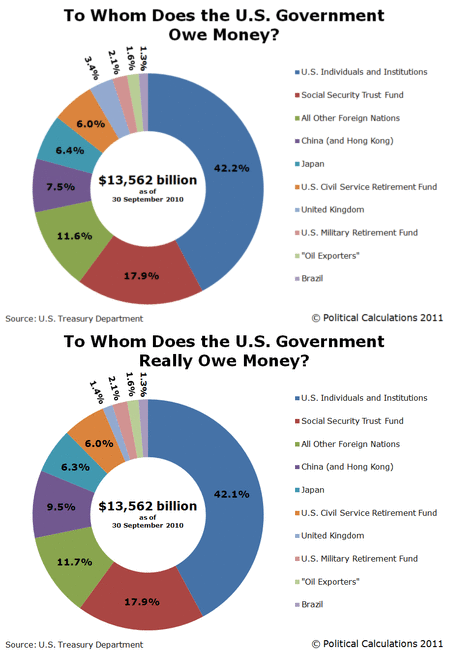
Note that the biggest change is that the share of U.S. government-issued debt held by China increases at the expense of the originally reported level of U.S. Treasuries held in the U.K. We anticipate a similar change when the data is revised in 2012, although this year, Europe's ongoing debt crisis might be playing a role in inflating the U.K.'s reported share of U.S. Treasury securities as well.
Previously on Political Calculations
Who Owns the U.S. National Debt
To Whom Does the U.S. Government Really Owe Money?
Summer Update: To Whom Does the U.S. Really Owe Money
Data Sources:
Board of Governors of the Federal Reserve System. Monthly Report on Credit and Liquidity Programs and the Balance Sheet, October 2011. Table 1. Assets, liabilities, and capital of the Federal Reserve System.
Board of Governors of the Federal Reserve System. Monthly Report on Credit and Liquidity Programs and the Balance Sheet, October 2010. Table 1. Assets, liabilities, and capital of the Federal Reserve System.
U.S. Treasury Department. Major Foreign Holders of Treasury Securities. Accessed 6 December 2011.
U.S. Treasury Department. Monthly Statement of the Public Debt of the United States, September 30, 2011. Table III – Detail of Treasury Securities Outstanding, September 30, 2011.
Tuesday, December 6, 2011
Can Increasing the Minimum Wage Boost GDP?
Does increasing the minimum wage increase GDP?
Bloggingstocks' Joseph Lazaro outlined the theory that it might back on 1 August 2009, shortly after the U.S. federal minimum wage reached its current level of $7.25 per hour (emphasis ours):
... the U.S. Federal Reserve will be monitoring prices and costs to see if the higher minimum wage is creating inflation havoc at a time when U.S. businesses least need another concern to deal with. Businesses have enough to worry about; and some are struggling just to maintain operations for another quarter or two -- the recession has been that damaging.
But the Fed will also be looking for signs of another side-effect, and this one is a positive one: a GDP boost. That's because millions of workers are going to get a raise that they otherwise would not have gotten, and that will increase their purchasing power.
The significance? Some of those increased-pay workers will choose to spend -- perhaps buying a washer or drier, making a down payment on a used car, or paying down a debt. It's quite possible -- although in these "frugal consumer" economic times no one is certain- - that the wage hike will increase U.S. GDP, serving as a small engine of growth as the U.S. economy inches back toward health.
It's an intriguing possibility isn't it? But has it worked out that way?
One way we can find out if boosting the federal minimum wage has boosted GDP is by examining the economic fortunes of the people most likely to be earning minimum wages in the United States: teenagers and young adults!
Together, individuals between the ages of 15 and 24 have consistently made up approximately one half of all minimum wage earners, so we should be able to use the personal income data the U.S. Census has collected and published for this age group for each year since 1994.

First, let's consider the population of 15-24 year olds in the United States, and the number of those individuals counted as having income from 1994 through 2010.
Over this time, the federal minimum wage has increased from $4.25 per hour in 1994, to $4.75 in 1996 and then 50 $5.15 per hour in 1997, where it held level until 2007. Beginning in 2007, it was increased by 70 cents per hour once a year up until it reached its current level of $7.25 per hour in 2009.
What we see however is that the number of teens and young adults with incomes has fallen over time. Our next chart shows the percentage of Americans between the ages of 15 and 24 who were counted as having income in the U.S. Census' Current Population Survey for each year from 1994 through 2010.

In this chart, we find that the percentage of teens and young adults who had incomes peaked in 1995, with 75.3% of the entire Age 15-24 population counted as having earned income in that year, which has since fallen to 59.9% as of 2010.
So far, both these charts indicate that the number of teens and young adults in the U.S. workforce has fallen from 1995 through 2010 - these charts don't tell us anything about how teens and young adults might have benefited from higher pay obtained through a rising minimum wage over time!
For that, we'll dig deeper in the U.S. Census' data and extract the data for the aggregate amount of income earned by individuals Age 15-24. Since one way of measuring the U.S. Gross Domestic Product is to add up all the income earned by people in the United States, we can use the Census' estimate of the aggregate income earned by U.S. teens and young adults to represent their contribution to the U.S.' GDP.
The easiest way to do that is to compare the amount of income earned by all U.S. teens and young adults in 1995, when the percent share of teens in the U.S. workforce peaked with the total amount of income earned by all U.S. teens and young adults in 2010, the most recent year for which we have data.

Coincidentally, selecting these particular years for comparision works especially well for our purposes, since it spans the increases in the U.S. minimum wage from $4.25 per hour to $7.25 per hour, with 1995 being one year before the first minimum wage increase in our period of interest occurred, and 2010 being one year after the most recent increase in the U.S. minimum wage took place.
We'll also adjust the numbers to account for the effect of inflation, using an animated chart to show the results.
What we find in examining this chart is that for the 15 year span from 1995 to 2010, the nominal aggregate income of U.S. teens and young adults increased by 14.75%, from roughly $302.9 billion to $347.5 billion.
But most remarkably, in terms of constant 2010 U.S. dollars, the aggregate income of U.S. teens and young adults fell by 0.56% from $349.5 billion in 1995 to $347.5 billion in 2010. For all practical purposes, despite a 70.6% increase in the nominal value of the U.S. federal minimum wage from $4.25 to $7.25 (a 21.8% increase in real terms), the total amount of income collectively earned by the predominant earners of the U.S. minimum wage in the United States is unchanged.

Let's take a step backwards and consider the nominal income distribution of teens and young adults in both 1995 and 2010 in nominal terms.
Our next animated chart shows how many thousands of Age 15-24 individuals the U.S. Census counted within each $2,500 increment of total money income in both 1995 and 2010.
Here, we find that the distribution of income has shifted primarily at the lower end of the income spectrum. Our final chart quantifies the changes for each of the U.S. Census' measured income increments.
Here, we note that an individual earning the U.S. federal minimum wage of $7.25 per hour in 2010 who works full time (2,080 hours per year = 8 hours a day, 5 days per week, 52 weeks per year), would earn $15,080 in a year. That puts all the income affected by increases in the U.S. federal minimum wage over time below this level.

What we find is that this income range at the lowest end of the income spectrum for Americans between the ages of 15 and 24 is the only income range where there have been reductions in the number of individuals with incomes between 1995 and 2010.
We also find that the number of individuals with incomes below $15,000 has fallen by 5,045,000 from 1995 to 2010. Meanwhile, we find that the number of Age 15-24 individuals with incomes over $15,000, which would be considered to be largely unaffected by increases in the U.S. federal minimum wage over time, has increased by 3,105,000.
Overall, there are 1,940,000 fewer individuals between the ages of 15 and 24 with incomes in 2010 than in 1995.
Consequently, we find that increasing the federal minimum wage has failed to increase GDP over time. Worse, we find that increasing the federal minimum wage has actually increased income inequality within the Age 15-24 population from 1995 through 2010, as the same aggregate income, when adjusted for inflation, is effectively being spread among nearly two million fewer people.
Returning to Joseph Lazzaro's thoughts on the topic:
... if the Fed and other organizations can verify that the minimum wage increase has boosted GDP without a loss of jobs, or inflation, Congress may to consider another decision in the quarters ahead: a decision to raise the federal minimum wage again, this time to $8.25 per hour.
In our view, the only reason the U.S. Congress would choose to increase the federal minimum wage again would be to ensure the onset of a new recession.
This concludes our annual anniversary post, where we celebrate the biggest ideas we've developed during the past year! This year's anniversary post was a bit unique in that it combines two of the areas in which we've made a mark (or left one!): the real impact of minimum wages on the U.S. teen population and the real nature of income inequality in the United States.
As for the biggest ideas we've developed in previous years, here's the list:
- 2005: A Year's Worth of Tools - we celebrated our first anniversary by listing all the tools we created in our first year. There were just 48 back then. Today, there are over 259....
- 2006: The S&P 500 At Your Fingertips - the most popular tool we've ever created, allowing users to calculate the rate of return for investments in the S&P 500, both with and without the effects of inflation, and with and without the reinvestment of dividends, between any two months since January 1871.
- 2007: The Sun, In the Center - we identify the primary driver of stock prices and describe a whole new way to visualize where they're going (especially in periods of order!)
- 2008: Acceleration, Amplification and Shifting Time - we apply elements of chaos theory to describe and predict how stock prices will change, even in periods of disorder.
- 2009: The Trigger Point for Taxes - we work out both when, and by how much, U.S. politicians are likely to change the top U.S. income tax rate.
- 2010: The Zero Deficit Line - a whole new way to find out how much federal government spending Americans can really afford!
Thank you for joining us for our anniversary! We appreciate that there are a lot of ways you can choose to spend your time, and we greatly appreciate your willingness to share so much of it with us over the past year.
Subscribe to:
Posts (Atom)